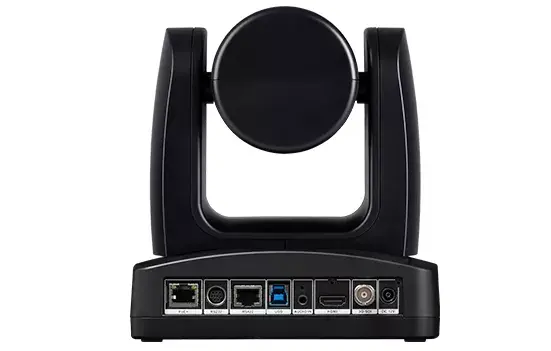
-
Digital zoom:
Indicates the digital zoom capacity, the number of times that the picture is enlarged thanks to digital technology.
-
1 x
-
Megapixel (approx.):
The number (in millions) of light-sensitive picture elements known as pixels actually used by the camera's image sensor (CCD) to record light, and which are reflected to the final number of recorded pixels stored on the memory card.
-
8 MP
-
Optical zoom:
Indicates the optical zoom capacity, which is the number of times that the picture can be enlarged with the optics of the camera.
-
30 x
-
Aperture range (F-F):
Aperture range of the device's optics, expressed in f-stops.
-
1.8 - 4.7
-
White balance:
Technique in photography and image processing, which involves a global adjustment of the intensities of the colors (typically red, green, and blue primary colors). An important goal of this adjustment is to render specific colors – particularly neutral colors including white – correctly.
-
Auto, Manual
-
Supported protocols:
-
IPv4, TCP, UDP, ARP, ICMP, IGMP, HTTP, HTTPS, DHCP, RTP / RTCP, RTSP, RTMP, SRT, HLS, NDI, LLDP, VISCA over IP
-
Focal length range:
Measure of how strongly the system converges or diverges light. For an optical system in air, it is the distance over which initially collimated rays are brought to a focus. A system with a shorter focal length has greater optical power than one with a long focal length; that is, it bends the rays more strongly, bringing them to a focus in a shorter distance.For an optical system in air, the effective focal length (f and f′) gives the distance from the front and rear principal planes (H and H′) to the corresponding focal points (F and F′).
-
4.5 - 135
-
Sensor type:
A sensor is a convertor than measures a physical quality (light, temperature etc.) and displays this electronically on a device.
-
Exmor CMOS
-
Minimum illumination:
Also known as light sensitivity, this is the smallest amount of light needed for the camera to produce an image of useable quality.
-
0.5 lx
-
Optical sensor size:
Optical sensors are electronic detectors that convert light, or a change in light, into an electronic signal. They are used in many industrial and consumer applications e.g. lamps that turn on automatically in response to darkness. Optical sensors come in many sizes.
-
25.4 / 2.8
-
Tilt angle range:
-
-30 - 90
-
Closest focusing distance:
-
0.1 m
-
Pan range:
-
-170 - 170
-
Resolution at capture speed:
-
3840x2160@60fps
-
Remote control type:
-
IR
-
HDMI ports quantity:
The number of sockets (ports) for HDMI connections. HDMI (High-Definition Multimedia Interface) is a compact audio/video interface for transferring uncompressed video data and compressed/uncompressed digital audio data from a HDMI-compliant device ("the source device") to a compatible computer monitor, video projector, digital television, or digital audio device. HDMI is a digital replacement for existing analog video standards.
-
1
-
Supported video modes:
The video modes that can be displayed by the device.
-
720p, 1080p, 2160p
-
Combined zoom:
-
30 x
-
Video formats supported:
The type of video formats that can be used by this device.
-
H.264, H.265
-
Maximum video resolution:
This is the maximum resolution of video images. Resolution is a measure of the degree of detail visible.
-
3840 x 2160
-
Maximum frame rate:
This is the maximum frame rate, also known as frame frequency and frames per second (FPS). It is the frequency (rate) at which an imaging device produces unique consecutive images called frames. The term applies equally well to film and video cameras, computer graphics, and motion capture systems. Frame rate is most often expressed in frames per second (FPS) and is also expressed in progressive scan monitors as hertz (Hz).
-
60 fps
-
RS-422 ports:
-
1
-
Operating current:
-
5 A
-
Other operating systems supported:
-
ChromeOS
-
Camera type:
There are a number of common types of digital cameras: compact cameras, bridge cameras, mirrorless interchangeable-lens cameras (MILC) and single lens reflex (SLR) cameras. Bridge cameras 'bridge the gap' between the low-end compact and high-end professional (SLR) cameras. Also MILCs populate this mid-segment by combining the larger sensors and interchangeable lenses of DSLRs with the live-preview viewing system of compact cameras.
-
Single camera
-
AC input frequency:
-
50 - 60
-
AC input voltage:
The voltage of the AC electricity that is inputted into the product.
-
100 - 240
-
Number of TV lines:
-
1600
-
Field of view (FOV) angle:
-
69.2 °
-
Horizontal field of view:
-
82.3 °
-
Vertical field of view:
-
37.3 °
-
Fastest camera shutter speed:
The minimum time which the camera shutter is open when taking a photo.
-
1/32000
-
Slowest camera shutter speed:
The maximum time which the camera shutter is open when taking a photo.
-
1 s
-
HD type:
Type of supported High Definition (e.g. Full HD, 4K Ultra HD).
-
4K Ultra HD
-
Tilt speed (min):
-
0.1 °/sec
-
Tilt speed (max):
-
200 °/sec
-
Pan speed (min):
-
0.1 °/sec
-
Pan speed (max):
-
200 °/sec
-
Gain control type:
-
Auto/Manual
-
Pan preset speed:
-
200 °/sec
-
Tilt preset speed:
-
200 °/sec
-
USB 3.2 Gen 1 (3.1 Gen 1) Type-B ports quantity:
-
1
-
3G-SDI output:
-
Yes
-
Tracking modes:
-
Zone mode, Presenter mode